


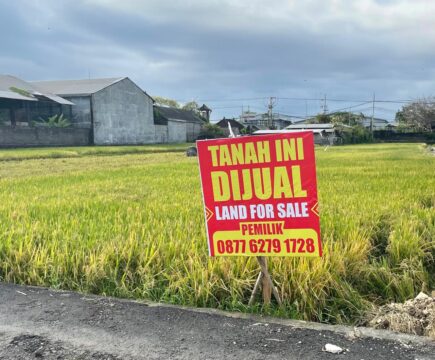
Kompas.com reports that the Bali Provincial Government is once again threatening to halt the increasingly alarming rate of agricultural land conversion to other purposes.
Bali Gubernatorial Decree Number 5 of 2025, Governor Wayan Koster prohibited the conversion of rice fields to non-agricultural areas, including the construction of villas and tourism properties. That instruction mandated that agricultural land in Bali, particularly Sustainable Food Crop Land (LP2B) and Rice Field Standard Area (LBS), must be strictly protected from further development.
The 2025 decree was enacted into law on December 2, 2025.
According to social media reports, despite the codification of laws prohibiting the conversion of rice fields into villa projects, the construction of villas on agricultural land appears to be continuing at an unabated pace. As reported by Kompas.com, Building Construction Approvals (PBG) and Certificates of Functional Worthiness (SLF) are being rejected by the OSS (Online Single Submission) licensing approval system.
The PBG is an official permit that replaces the IMB and must be obtained before constructing, modifying, or maintaining a building to meet technical standards.
Meanwhile, the SLF is the legal document issued by the regional (or central) government stating that a building has been completed and meets the technical and administrative requirements for use.

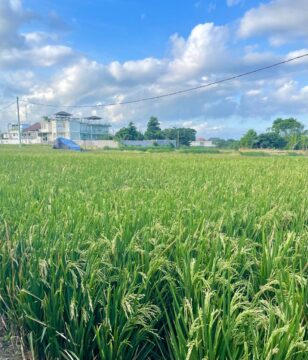
According to the official Bali Provincial Government website, the permit system is intended to maintain the availability of productive agricultural land while strengthening food sovereignty on the Island of the Gods. These steps are part of efforts to realize the regional development vision of “Nangun Sat Kerthi Loka Bali”, a Balinese slogan that emphasizes the need to maintain balance between nature, humans, and culture.
”We must ensure the balance between nature, humans, and culture is maintained. If agricultural land continues to shrink, food sustainability and harmony in Bali will be threatened,” said Bali Governor Wayan Koster, on Friday, 24 April 2026. The Governor publicly proclaims that without strong protection, the shrinking of rice fields will threaten the sustainability of the agricultural sector, which has long been a foundation of Bali’s economy and culture.
Bali’s shrinking agricultural land is also cited as a contributing factor in the devastating floods affecting the Island.
Now, under the law, all Regents and the single Mayor in Bali are prohibited from approving the conversion of agricultural land, especially LP2B and LBS, for non-agricultural purposes. This is presumed to mean that development projects – such as villas, hotels, and other commercial facilities – are no longer allowed to convert protected rice fields.
Moreover, district/city governments are now being asked to reject any revision to spatial planning that could reduce the amount of agricultural land. Protection of agricultural land is also strengthened through spatial planning policies. These instructions expressly prohibit and change the land designated as LP2B and LBS in the current Regional Spatial Plan (RTRW) and Detailed Spatial Plan (RDTR) documents.
If enforced, the scope for converting rice fields into development areas will be severely limited, as they are now presumably “locked down” by regional planning regulations.
Koster has revealed that productive rice fields in Bali now total only some 68,000 hectares. “It continues to decline. During my first term, it was around 71,000 hectares,” commented Koster on Wednesday, 25 March 2026. The remaining land, approximately 44 hectares (65 percent), is organic rice fields.
”I ask the leadership and members of the council to continue monitoring so that this conversion of productive land can be controlled. Because if not controlled, the conversion of productive land will increase and will threaten food security,” Koster explained.
Under the new regulatory regime, owners, builders, and developers of villa projects built illegally on agricultural land can now face criminal charges. This Governor’s instruction was not issued without reason. The policy was a response to a 2025 letter from the Minister of Agriculture highlighting the high rate of rice field conversion in Bali.
The rapid growth of the tourism sector is a major driver of the conversion of agricultural land into commercial properties. If left unchecked, this situation is feared to erode Bali’s agrarian identity and threaten regional food security. Law enforcement of the ban on land conversion is in strict accordance with Law Number 41 of 2009. That law states that converting LP2B land can result in a prison sentence of up to 5 years. In addition to the administrative ban, the government also emphasizes the importance of strict supervision in the field. Supervision will be extended to the village and hamlet levels to ensure that no violations go unnoticed or unpunished.
Related Links
Bali to Ban Building More Hotels, Villas, & Restaurants
Governor Koster: No Moratorium on Hotels & Villas
Escalating Overtourism in Bali
Moratorium on Development: 2 or 10 Years?
Equitable Approach to Tourism Development
Support Grows for 2-Year Bali Moratorium
Time for Moratorium on S. Bali Development?
BTB-GIPI Supports Bali Hotel Moratorium
Megawati Wants Bali Hotel Moratorium
Bali to Limit Number of Foreign Tourists?
Stay Informed on Bali Tourism-Related News: Subscribe to Bali Update